
Who Actually Needs a GMT Watch?
Yes, if you regularly need a second time zone, want a quick 24-hour AM/PM reference, or simply love the multi-time-zone styling. Skip it if you would never set the GMT hand and want the thinnest or simplest watch available.
Smartphones automatically adjust local time zones using cellular networks, leaving many watch enthusiasts to wonder whether paying for a fourth hand is truly necessary. A GMT watch can show a second time zone using a dedicated 24-hour hand across the dial, providing an immediate visual reference without requiring you to unlock a digital device. Determining whether how a GMT watch works translates into practical daily value ultimately comes down to how you live, travel, and conduct business across borders.
Quick Self-Check: Will You Actually Use a GMT?
Before investing in a GMT watch, score yourself against these six straightforward daily scenarios:
- Do you fly across multiple time zones several times a year?
- Do you regularly collaborate with remote colleagues, clients, or markets in another time zone?
- Do you frequently place calls to family members or friends living abroad?
- Would a distinct 24-hour AM/PM visual cue help prevent confusion when you are jet-lagged?
- Do you prefer a functional sport watch and aviation styling on your wrist?
- Would you rather glance down at your wrist than pull out and unlock your smartphone during a meeting?
Your Score:
- 3 or more "Yes" answers: A GMT watch will earn its place on your wrist, providing genuine functional convenience during your routine.
- 1 to 2 "Yes" answers: You will likely buy the watch for its dynamic design, bezel styling, and horological heritage, but recognize that you will rarely set the fourth hand.
- 0 "Yes" answers: You are paying for a feature you will ignore- a standard time-and-date watch is likely a better fit for choosing a watch for your daily routine.
What a GMT Actually Does for You

A GMT watch provides a unique mechanical solution for tracking time across borders. Rather than replacing your main clock, it adds layered functional benefits:
- Dual Time-Zone Tracking: Read your home time and local time simultaneously without pushing buttons or switching digital modes.
- 24-Hour AM/PM Orientation: The 24-hour hand rotates once per day across a 24-hour scale, eliminating confusion about whether it is day or night in a distant city.
- Third Time-Zone Capability: Models featuring a bidirectional rotating 24-hour bezel allow you to temporarily align the bezel to reference a third time zone on the fly.
- Discreet Reference: Check cross-border working hours during business meetings or international flights without checking a phone screen.
Who Actually Needs One
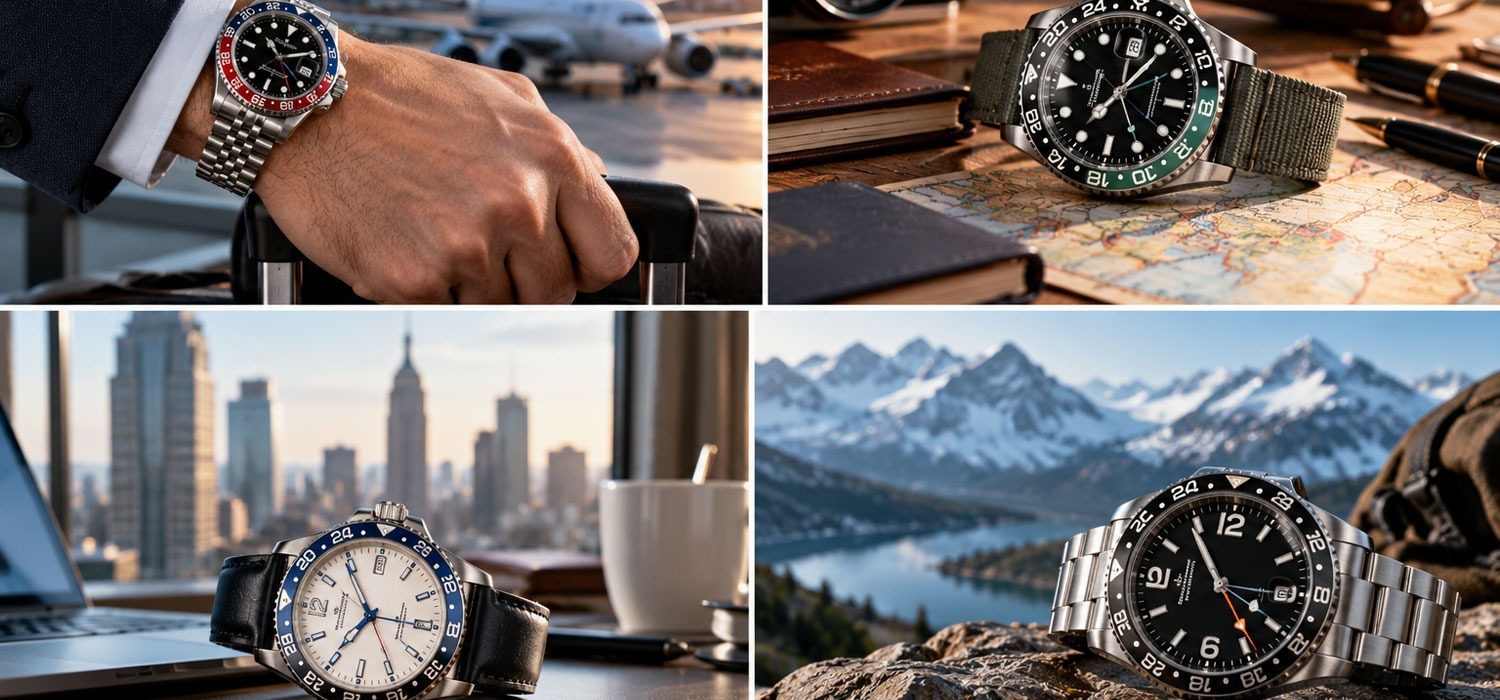
Different lifestyles demand different timekeeping tools. Below is a breakdown of reader profiles to help match your daily needs with the appropriate GMT configuration:
|
Reader Profile |
Is a GMT Worth It? |
Recommended GMT Type |
|
Frequent Traveler |
Yes - Highly practical |
Traveler ("True") GMT |
|
Remote / Global Worker |
Yes - Convenient |
Caller ("Office") GMT |
|
Family / Friends Abroad |
Yes - Functional |
Caller ("Office") GMT |
|
Pilot / Aviation Enthusiast |
Yes - Historical & practical |
Traveler GMT / UTC Reference |
|
Desk-Only Owner |
Optional - Style choice |
Caller GMT or Quartz GMT |
|
Design Collector |
Yes - Aesthetic choice |
Either (Focus on aesthetics) |
Frequent Travelers and Frequent Flyers
For cross-border travelers, a GMT watch (or "true GMT") is the ideal travel watch. This movement style allows you to independently adjust the local hour hand in one-hour increments as you land in a new time zone, while the 24-hour GMT hand continues pointing steadily to your home time. It represents the best travel watch design for keeping tabs on your home schedule while navigating foreign airports. (If you frequently cross many time zones simultaneously on short trips, compare GMT vs world timer options to see which multi-time-zone layout fits your workflow best.)
Remote and Global Workers
If you remain stationary at your home office but regularly coordinate projects across different global time zones, a caller (or "office") GMT offers direct convenience. On a GMT caller, adjusting the crown jumps the 24-hour GMT hand independently around the dial to track your offshore team, while your primary hour hand continues to display your local time.
Family and Friends Abroad
Maintaining personal connections across oceans becomes easier when you do not have to perform mental arithmetic before placing a call. Setting your 24-hour hand to match a relative's local scale lets you instantly confirm whether it is a reasonable hour to reach out.
Pilots and Aviation Fans
In aviation history, the original GMT-Master was developed for Pan Am pilots navigating transatlantic long-haul routes. Pilots frequently keep their 24-hour GMT hand aligned with Coordinated Universal Time (UTC), also referred to in aviation as "Zulu time," providing a constant standardized baseline for flight logging, weather updates, and navigation schedules.
Collectors and Design Buyers
You do not need to fly across continents to justify owning a compelling timepiece. Many watch enthusiasts buy a GMT simply for its distinct visual appeal, two-tone rotating bezels, and complex dial architecture. If you admire the aesthetic and are willing to accept the higher purchase price, buying for design alone remains a valid choice.
Who Probably Doesn't Need One
While GMT watches offer impressive utility, they are not the ideal choice for every wrist. You should likely skip a GMT watch if:
- You prefer clean, minimal dials: The extra 24-hour hand and outer bezel markings inherently add visual density to the watch face.
- You want an ultra-thin dress profile: The added gearing required for a fourth central hand increases case thickness, making it harder to fit under tight shirt cuffs- browse our men's dress watches for sleeker alternatives.
- You dislike ongoing mechanical maintenance: GMT movements with mechanical GMT functions feature additional internal wheel trains that require routine professional servicing over time.
Automatic or Quartz GMT?
Choosing the movement type for a GMT comes down to personal preference and maintenance requirements:
- Automatic GMT Watch: Powered by the kinetic motion of your body, an automatic GMT watch delivers traditional mechanical craftsmanship and a sweeping second hand. However, setting a multi-hand mechanical watch after it has run out of power requires extra time, and mechanical movements require long-term upkeep- consider the ongoing cost of servicing a watch when planning your purchase.
- Quartz GMT Watch: Battery-powered quartz GMT models run continuously with high accuracy, making them ideal grab-and-go travel watches. Brands like Timex offer accessible, low-maintenance quartz GMT options that are always set and ready to wear.
What to Look For in a GMT Watch
To ensure you acquire a genuine GMT timepiece that satisfies your functional needs, check these vital construction factors before making a purchase:
- Verify it is a genuine GMT: Ensure the watch possesses a true fourth central 24-hour hand paired with a 24-hour scale. Beware of "lookalike" sport watches that feature a two-tone bezel but lack a dedicated 24-hour hand.
- Select the correct movement type: Decide between a traveler GMT (for jumping your local hour hand when arriving in new cities) or a caller GMT (for tracking remote time zones from home).
- Check the bezel movement: A bidirectional 24-hour rotating bezel lets you quickly align the hour hand to calculate a third time zone.
- Evaluate hand legibility and lume: The GMT hand should stand out distinctly in color or shape from the primary hour and minute hands, with strong luminous coating for nighttime legibility.
- Confirm date wheel mechanics: On traveler GMT movements, check that the date wheel advances forward or backward in tandem with the local hour hand as it jumps across midnight.
Budget Tiers and Brands to Start With
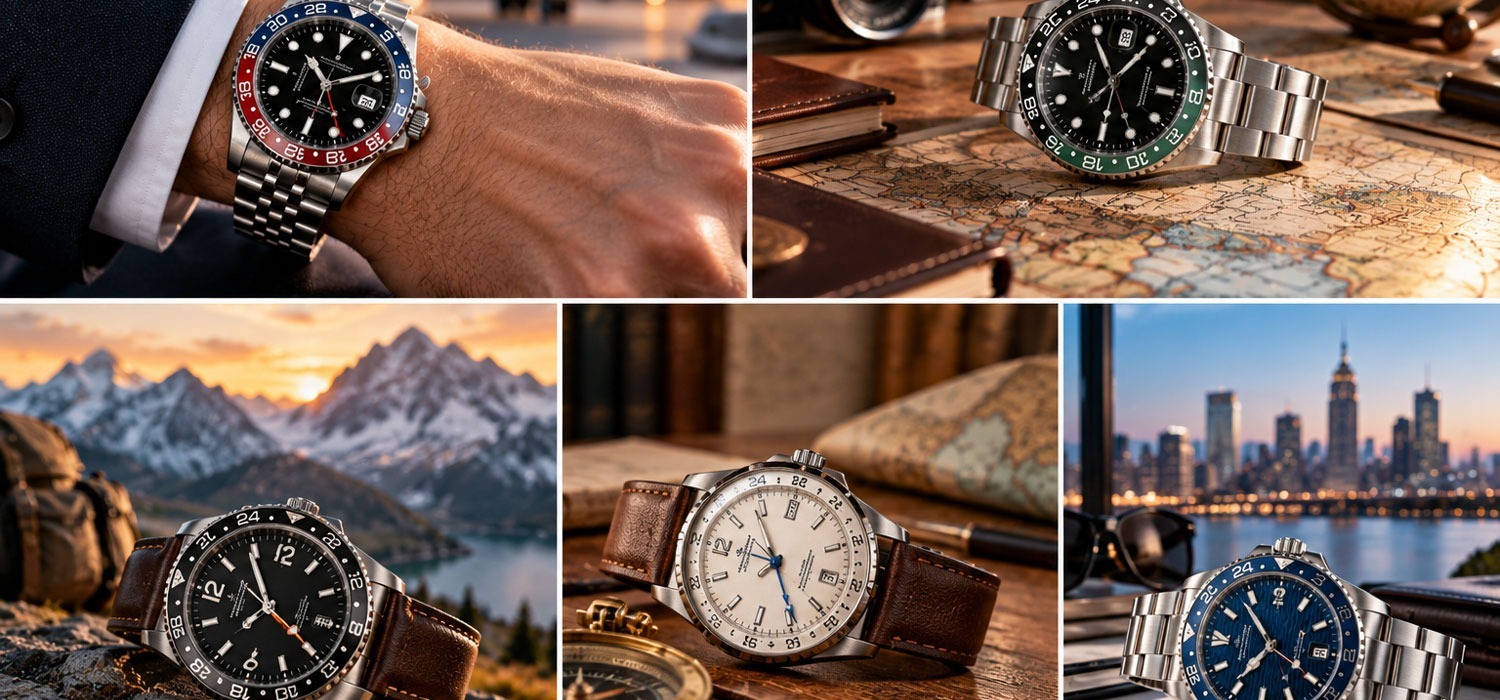
GMT timepieces span a wide variety of price and quality tiers across the industry:
- Entry Tiers: Dependable, accessible entry points in both automatic and quartz configurations are crafted by brands like Seiko (featuring the Seiko 5 Sports GMT series), Citizen, and Timex.
- Mid-Range Tiers: Mid-tier Swiss timepieces offering uplifted case finishing, sapphire crystals, and precise movements are represented by makers such as Tissot and TAG Heuer.
- Upper Tiers: Heritage Swiss horology, built with specialized in-house calibers and luxurious materials, is headlined by brands like Tudor and Omega.
- Pre-Owned Options: Buying pre-owned is an excellent way to access higher-tier GMT models at more approachable prices. When shopping, browse trusted pre-owned watches and review our guide on how to choose a pre-owned watch to verify the box, papers, and service history.
Is a GMT Watch a Good Investment?
A GMT watch should be purchased to be worn and enjoyed, not as a speculative financial investment. The presence of a GMT complication alone does not guarantee value retention over time.
A watch's long-term resale value is driven primarily by overall brand prestige, condition, original documentation, and market demand, rather than the movement's fourth hand. To better learn about value retention dynamics in watchmaking, read how brand reputation affects resale value and examine whether expensive watches are always better.
Frequently Asked Questions
1: Is a GMT watch worth it if I don't travel?
Yes, if you regularly work with offshore teams, keep in touch with family abroad, or enjoy multi-time-zone sport styling on your wrist.
2: Which GMT type is best for travelers?
A traveler (or "true") GMT is best because its local hour hand jumps independently in one-hour increments without stopping the second hand or shifting your home time.
3: Are GMT watches reliable?
Yes, GMT watches from established manufacturers are highly reliable- overall durability depends on the base movement quality and regular maintenance rather than the GMT hand itself.
4: How long do GMT watches last?
A quality GMT watch can last for generations with routine care and periodic mechanical servicing.
5: Can a GMT watch be worn every day?
Yes, most GMT models are built in durable stainless-steel cases with sport-level water resistance, making them great choices for daily wear.
6: How do I know a watch is a real GMT?
A real GMT watch features four central hands- hour, minute, second, and a dedicated 24-hour GMT hand- paired with a 24-hour scale on the dial or bezel.
Final Verdict
Deciding if a GMT watch is worth it depends on your lifestyle. If you frequently cross time zones or coordinate across borders, a GMT watch serves as a stylish, functional timekeeping companion. Choose between traveler and caller movements based on your habits, select an automatic or quartz engine that fits your daily routine, and buy a watch you genuinely enjoy wearing.
Check out our full inventory of authentic timepieces across our men's sport watches collection or browse our complete array of pre-owned watches to find your next timekeeping companion today.
Newest Guide & Blog Updates

Who Actually Needs a GMT Watch?
Yes, if you regularly need a second time zone, want a quick 24-hour AM/PM reference, or simply love...

GMT vs. World Timer Watches: What's the Difference?
A GMT watch tracks one additional time zone, while a world timer watch displays all 24 standard tim...

What Is a GMT Watch and How Does It Work?
A GMT watch is a wristwatch that displays a second time zone using an additional hand that complete...

How to Match a Watch Strap to Your Style and Occasion
Your watch looks perfect with jeans, but something feels wrong when you wear it with a suit. Or per...

How to Choose the Right Watch Strap Material
Your watch strap does more than hold your watch in place. It affects how comfortable your wrist fee...

Watch Bracelets vs. Leather Straps: Which Is Right for You?
You've found the watch you want, but there's one decision left. Should you buy it with a metal brac...