
What Is a GMT Watch and How Does It Work?


A GMT watch is a wristwatch that displays a second time zone using an additional hand that completes one rotation every 24 hours. This GMT hand indicates towards a 24-hour scale on the dial or bezel, allowing you to read the time in another location without changing your local time.
If you've noticed a fourth hand or numbers running from 2 to 24 around a watch dial, you've probably encountered this feature.
Understanding what a GMT watch is involves learning three things: what the extra hand does, how to read the 24-hour scale, and how to set the watch correctly.
What Is a GMT Watch?
A GMT watch can display two time zones simultaneously. It uses conventional hour and minute hands for local time and an additional 24-hour hand for a second location. Some models also feature a rotating bezel that allows you to track a third time zone.
In watchmaking, this additional function is called a complication.
A complication is any feature beyond basic timekeeping, like date display, chronograph, or GMT function. You can learn more about how a chronograph complication works.
What Does GMT Stand for on a Watch?
GMT stands for Greenwich Mean Time, a historical international time reference based on the mean solar time at Greenwich, England.
Greenwich Mean Time served as an international reference until Coordinated Universal Time became the modern standard in 1972.
The term GMT remains widely used in watchmaking to describe watches capable of displaying another time zone.
GMT vs. UTC: What's the Difference?
GMT is a historical time standard, while UTC, or Coordinated Universal Time, is the modern international standard used for precise timekeeping.
For everyday watch use, GMT and UTC generally represent the same reference time, with a zero-hour offset.
Pilots and aviation personnel may also refer to UTC as Zulu time.
GMT Watch vs. Regular Watch
A traditional analog watch uses hour, minute, and often second hands to display time in a single time zone.
A GMT watch adds another hand that follows a 24-hour cycle.
This allows you to monitor local time and another location without changing the main display.
Anatomy of a GMT Watch
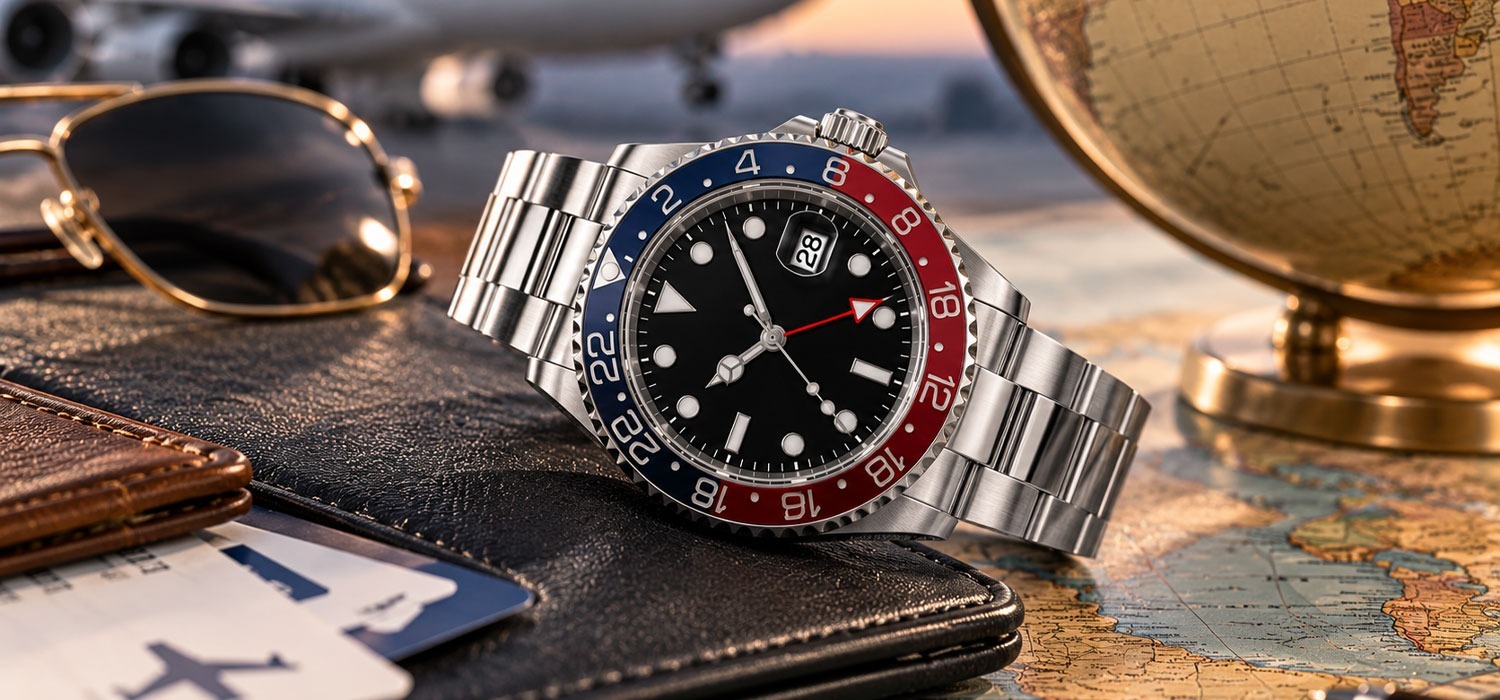
A GMT watch usually includes the familiar components of a traditional wristwatch, plus a separate GMT hand and a 24-hour scale. The extra hand moves at half the speed of the normal hour hand, making one complete rotation each day instead of two.
Understanding these parts makes reading and setting the watch much easier.
The GMT Hand
The GMT hand is usually visually different from the conventional hour and minute hands.
Manufacturers often use a contrasting color or an arrow-shaped tip to make it easier to identify.
Unlike the standard hour hand, which completes two rotations every 24 hours, the GMT hand completes only one.
Its position indicates the hour in your selected second time zone.
The 24-Hour Scale and GMT Bezel
The 24-hour scale displays hours from 0 to 23 or uses numerals such as 2, 4, 6, and 24.
It may appear on a fixed bezel, rotating bezel, or inner chapter ring surrounding the dial.
Some rotating GMT bezels use two colors to separate daytime and nighttime hours visually.
A rotating bezel can also provide a reference for another time zone.
Other familiar parts include the standard hour, minute, and seconds hands, plus an optional date window.
How a GMT Watch Works
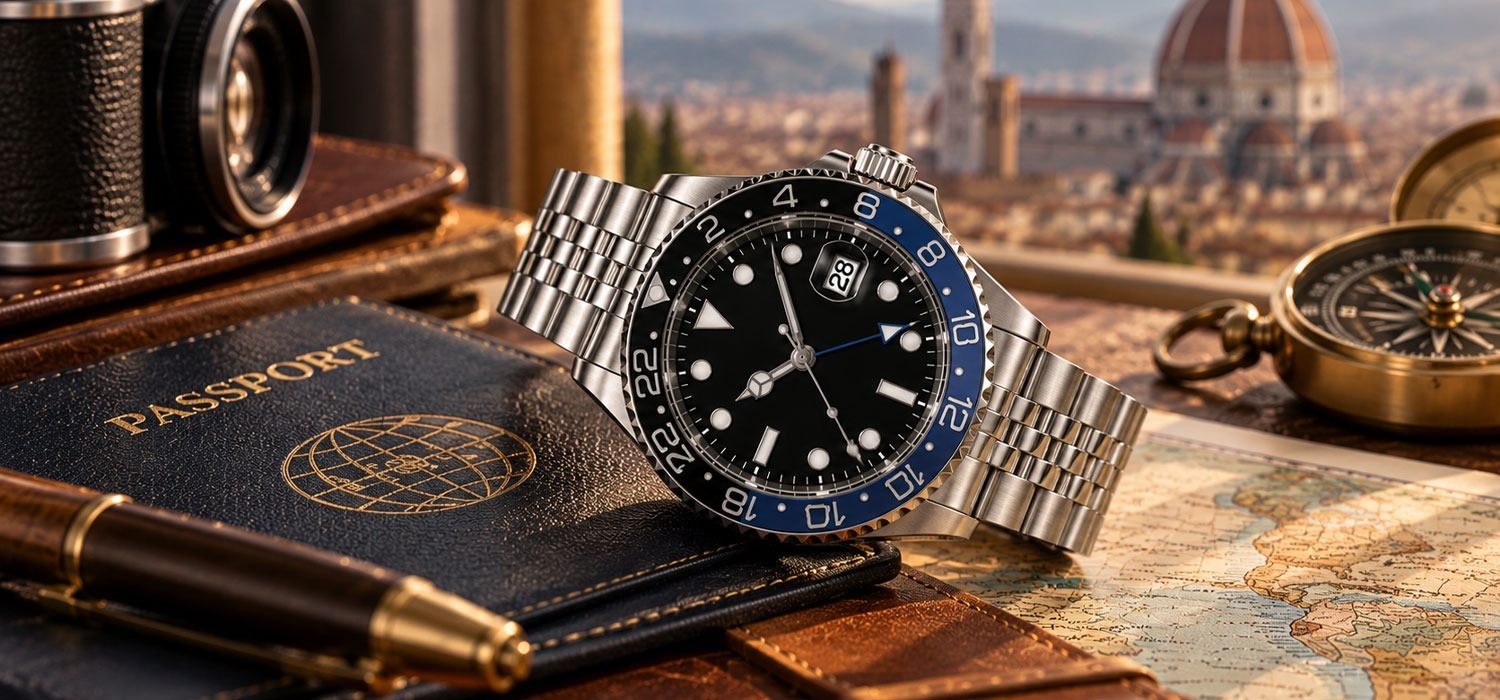
A GMT watch works by connecting an additional hand to its movement so that the hand rotates once every 24 hours. This hand displays a second time zone when read against the corresponding 24-hour scale. The regular hour and minute hands continue showing local time.
The normal hour hand completes one revolution every 12 hours.
The GMT hand moves at half that rate, completing a single revolution every 24 hours.
This allows the extra hand to distinguish between morning and evening at the second location.
Fixed vs. Rotating GMT Bezel
Fixed 24-Hour Scale
A fixed scale displays the time in one additional location using the GMT hand.
You read the GMT hand directly against the markings surrounding the dial.
Rotating 24-Hour Bezel
A rotating bezel allows you to shift the hour reference without changing the GMT hand.
By rotating the bezel to the appropriate offset, you can calculate the time in a third location.
This feature is particularly useful when you occasionally need to check another international time zone.
How to Read a GMT Watch
To read a GMT watch, check the regular hour and minute hands for local time. Then locate the GMT hand and read the number it points to on the 24-hour scale. The minute hand is generally shared between both time displays.
Follow these steps:
Step 1: Read Your Local Time
Start with the regular hour and minute hands.
For example, imagine you're in New York, and the local time is 3:00 p.m.
Your standard watch hands show 3:00.
Step 2: Find the GMT Hand
Locate the additional hand, usually marked by a contrasting color or arrow-shaped tip.
Suppose you've set it to display the time in London.
Step 3: Read the 24-Hour Scale
During winter, London is five hours ahead of New York.
If it's 3:00 p.m. in New York, it's 8:00 p.m. in London.
The GMT hand therefore points to 20 on the 24-hour scale.
The number 20 represents 20:00, or 8:00 p.m.
Step 4: Use the Minute Hand
The GMT hand indicates the hour in the second time zone, while the standard minute hand provides the minutes.
If your watch shows 3:30 p.m. in New York, the second time would be 8:30 p.m. in London during this example.
Reading a Third Time Zone
If your GMT watch has a rotating 24-hour bezel, you can use it to reference another location.
Suppose you want to check a city three hours ahead of London.
Rotate the bezel by three hours relative to the original 24-hour reference in the direction that makes the GMT hand indicate a time three hours later.
Instead of reading 20, the GMT hand would now indicate 23, or 11:00 p.m.
Remember to return the bezel to its original alignment when you want to read your usual second time zone.
Important: Standard GMT hands generally operate in whole-hour increments. Locations with 30-minute or 45-minute offsets, such as India or Nepal, may require additional calculation.
How to Set a GMT Watch
Setting a GMT watch depends on whether it has an independently adjustable GMT hand or a local hour hand. These designs are commonly called caller GMT and traveler GMT, respectively.
Before adjusting your watch, check the manufacturer's instructions. Crown positions and movement mechanisms vary, and some watches have specific procedures for setting the date.
Setting a Caller or Office GMT Watch
A caller GMT allows you to adjust the GMT hand independently while the main hour hand remains your local-time reference.
- Set your local time. Pull the crown to the correct position and adjust the conventional hour and minute hands.
- Locate the GMT-setting position. Refer to your watch manual to identify the correct crown setting.
- Adjust the GMT hand. Move the additional hand until it points to the second location's hour on the 24-hour scale.
- Check the minutes. Confirm that the second location uses the same minute offset. Whole-hour GMT displays may require calculation for fractional offsets.
- Secure the crown. Return the crown to its normal position and screw it down if the watch uses a screw-down crown.
This arrangement is convenient when your local time rarely changes, but you regularly monitor another location.
Setting a Traveler or True GMT Watch
A traveler GMT allows the conventional local hour hand to move independently, usually in one-hour increments.
- Set the watch's reference time and GMT hand according to the manufacturer's instructions.
- When you arrive in another time zone, identify the difference between your original location and your destination.
- Move the local hour hand to adjust according to one-hour jumps.
- Confirm that the GMT hand continues displaying your selected reference time.
- Check the date and secure the crown.
The main advantage is that you can change local time without disturbing the minute hand or reference-time display.
Setting a Quartz GMT Watch
Quartz GMT watches may use different adjustment mechanisms.
Some have crown-controlled settings, while others use additional pushers or electronic controls.
Always go through the instructions for the specific model rather than assuming every GMT works identically.
Types of GMT Watches
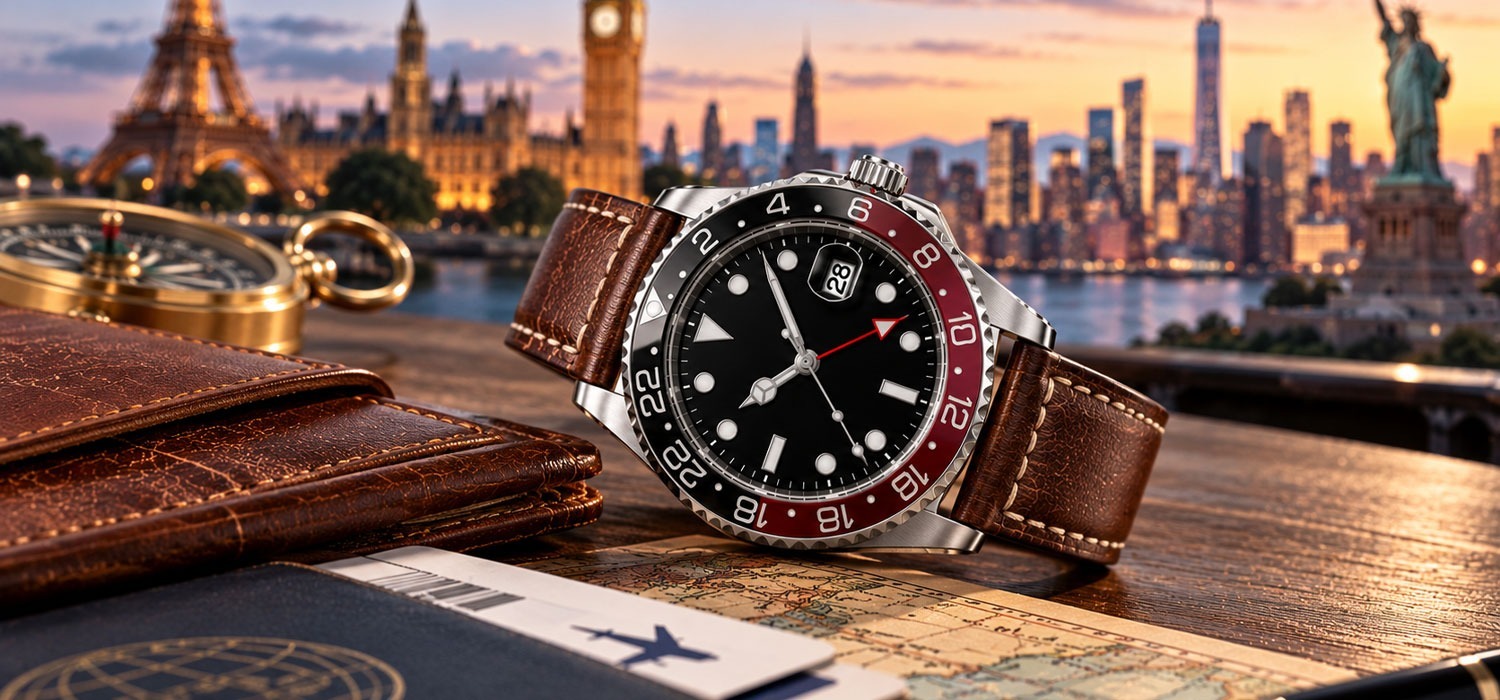
GMT watches differ in how their additional hands are adjusted and in the type of movement that powers them. The two main functional types are traveler GMT and caller GMT. Both display another time zone, but they handle time adjustments differently.
Traveler GMT vs. Caller GMT
|
Feature |
Traveler GMT |
Caller GMT |
|
Independently adjustable hand |
Local hour hand |
GMT hand |
|
Common alternative name |
True or flyer GMT |
Office GMT |
|
Useful for |
Frequent time-zone changes |
Monitoring another location from home |
|
Typical listing description |
Jumping local hour hand |
Independently adjustable GMT hand |
|
Main advantage |
Change local time without resetting reference time |
Change the second time zone directly |
A traveler GMT is useful when you frequently cross time-zone boundaries.
A caller GMT works well when you remain in one location but regularly check another country's time.
Both can display two time zones accurately when set correctly.
Brands associated with GMT watches include Omega, Tudor, TAG Heuer, and Rado.
Mechanical vs. Quartz GMT Watches
Not all GMT watches are automatic.
GMT functionality is available in both mechanical and quartz movements.
Mechanical GMT Watches
These may use automatic or manually wound movements to power the watch and GMT complication.
Quartz GMT Watches
A quartz GMT watch uses an electronic movement powered by a battery or another electrical source.
Quartz GMT watches are available across various price points and can provide convenient everyday timekeeping.
Brands such as Seiko offer watches with GMT functionality.
For a broader explanation, see our comparison of quartz, automatic, and mechanical movements.
GMT Watch vs. Dual-Time Display
A GMT watch displays another time zone using an additional hand on the main dial and a 24-hour scale.
A traditional dual-time watch may instead use a separate 12-hour subdial.
Some dual-time designs lack an AM/PM indicator, making it harder to determine whether the second location is in the morning or evening.
A world timer is another related complication that displays all 24 standard time zones through a city ring and a 24-hour ring.
Three Everyday Ways to Use a GMT Watch
GMT watches can help you monitor another time zone without relying on a phone or repeatedly adjusting your watch.
1. Traveling Between Time Zones
When traveling internationally, you can keep your home time displayed on the GMT hand while the standard hour and minute hands show your destination's local time.
This makes it easier to check the time back home without performing mental calculations.
2. Working With International Colleagues or Family
If you frequently communicate with someone living abroad, setting the GMT hand to their local time can simplify scheduling.
For example, you can check whether it's an appropriate time to call without opening a separate world clock.
3. Tracking UTC as a Reference
Pilots and aviation professionals historically used Greenwich Mean Time, now commonly referenced as UTC (Zulu time), to coordinate activities across international time zones.
A GMT watch can maintain that reference while the main hands display local time.
A Short History of the GMT Watch
GMT watches became particularly important during the growth of international aviation in the 1950s.
The Glycine Airman, introduced in 1953, is widely regarded as an early GMT wristwatch designed to help users track a second time zone.
Rolex later introduced the GMT-Master during the mid-1950s.
According to Rolex's historical account, the company partnered with Pan American World Airways in 1955, and the GMT-Master became associated with the airline's international flight operations.
Its distinctive two-tone bezel helped distinguish daytime from nighttime.
The GMT complication has since become a familiar feature of travel-oriented watches, with different manufacturers offering their own movement designs and adjustment methods.
Frequently Asked Questions
What Does GMT Stand for on a Watch?
GMT stands for Greenwich Mean Time. In watchmaking, it refers to a function that let the wearer to track another time zone using an additional 24-hour hand.
What Is the Difference Between GMT and UTC?
GMT is a historical time reference, while Coordinated Universal Time is the modern international standard. For everyday watch use, both generally refer to the same zero-hour time-zone offset.
Are All GMT Watches Automatic?
No. GMT watches are available with mechanical and quartz movements. Mechanical models may be automatic or manually wound, while quartz GMT watches use electronic timekeeping systems.
Can a GMT Watch Show Three Time Zones?
Yes. A GMT watch with a rotating 24-hour bezel can display local time, a second reference time using the GMT hand, and a third time through the adjusted bezel.
What Is a True GMT Watch?
A true GMT, also called a traveler or flyer GMT, allows the conventional local hour hand to move independently. This makes changing local time more convenient when traveling.
Does a GMT Watch Work for Half-Hour Time Zones?
A conventional GMT hand generally follows whole-hour increments. Time zones with 30-minute or 45-minute differences may require mental calculation or a specialized movement to display accurately.
Understanding GMT Watches Before You Buy
What is a GMT watch? It's a watch that displays another time zone through an additional 24-hour hand and corresponding scale.
Once you know how the hand moves, how to read the bezel, and whether the watch uses traveler or caller GMT functionality, the feature becomes easier to use.
Browse men's sport watches and pre-owned watches at Inventory Adjusters. You can also review which watch features actually matter when comparing timepieces.
Newest Guide & Blog Updates

Who Actually Needs a GMT Watch?
Yes, if you regularly need a second time zone, want a quick 24-hour AM/PM reference, or simply love...

GMT vs. World Timer Watches: What's the Difference?
A GMT watch tracks one additional time zone, while a world timer watch displays all 24 standard tim...

What Is a GMT Watch and How Does It Work?
A GMT watch is a wristwatch that displays a second time zone using an additional hand that complete...

How to Match a Watch Strap to Your Style and Occasion
Your watch looks perfect with jeans, but something feels wrong when you wear it with a suit. Or per...

How to Choose the Right Watch Strap Material
Your watch strap does more than hold your watch in place. It affects how comfortable your wrist fee...

Watch Bracelets vs. Leather Straps: Which Is Right for You?
You've found the watch you want, but there's one decision left. Should you buy it with a metal brac...