
GMT vs. World Timer Watches: What's the Difference?


A GMT watch tracks one additional time zone, while a world timer watch displays all 24 standard time zones simultaneously. A GMT typically uses an extra 24-hour hand, while a world timer combines a city ring with a rotating 24-hour scale.
When comparing GMT vs. world timer watches, the right choice depends on how many time zones you need to monitor and how quickly you want to read them.
Both belong to the category of watches with multiple-time-zone functions. However, they serve different purposes.
Quick Answer: GMT vs. World Timer
- Choose a GMT watch if you regularly monitor home time and one additional time zone.
- Choose a GMT with a rotating bezel if you occasionally need to track a third time zone.
- Choose a world timer if you want to see the time across 24 standard time zones without repeatedly adjusting your watch.
- Choose based on readability: GMT watches have simpler displays, while world timers provide more information on a busier dial.
These functions differ from other watch complications such as the chronograph, which measures elapsed time rather than displaying another time zone.
GMT vs World Timer at a Glance
The main difference between GMT and world timer watches is the number of time zones displayed. A GMT shows local time and another reference time, often with a rotating bezel for a third zone. A world timer uses city and 24-hour rings to show all 24 standard time zones at once.
|
Feature |
GMT Watch |
World Timer Watch |
|
Time zones shown |
Two, or three with a rotating bezel |
All 24 standard time zones |
|
How you read it |
Additional hand on a 24-hour scale |
City names aligned with a 24-hour ring |
|
Legibility |
Generally easier to read |
More information on the dial |
|
Typical layout |
Standard hands, GMT hand, optional bezel |
Central hands, city ring, 24-hour ring |
|
Changing zones while traveling |
Local-hour adjustment on traveler GMT models |
City selection or adjustment mechanism |
|
Best suited for |
Travelers monitoring home and local time |
People monitoring many international locations |
|
Dial complexity |
Usually moderate |
Generally more detailed |
|
Hybrid designs |
May include a city bezel |
May combine world-time markings with a GMT hand |
Both approaches are useful, but their displays prioritize different information.
What Is a GMT Watch?
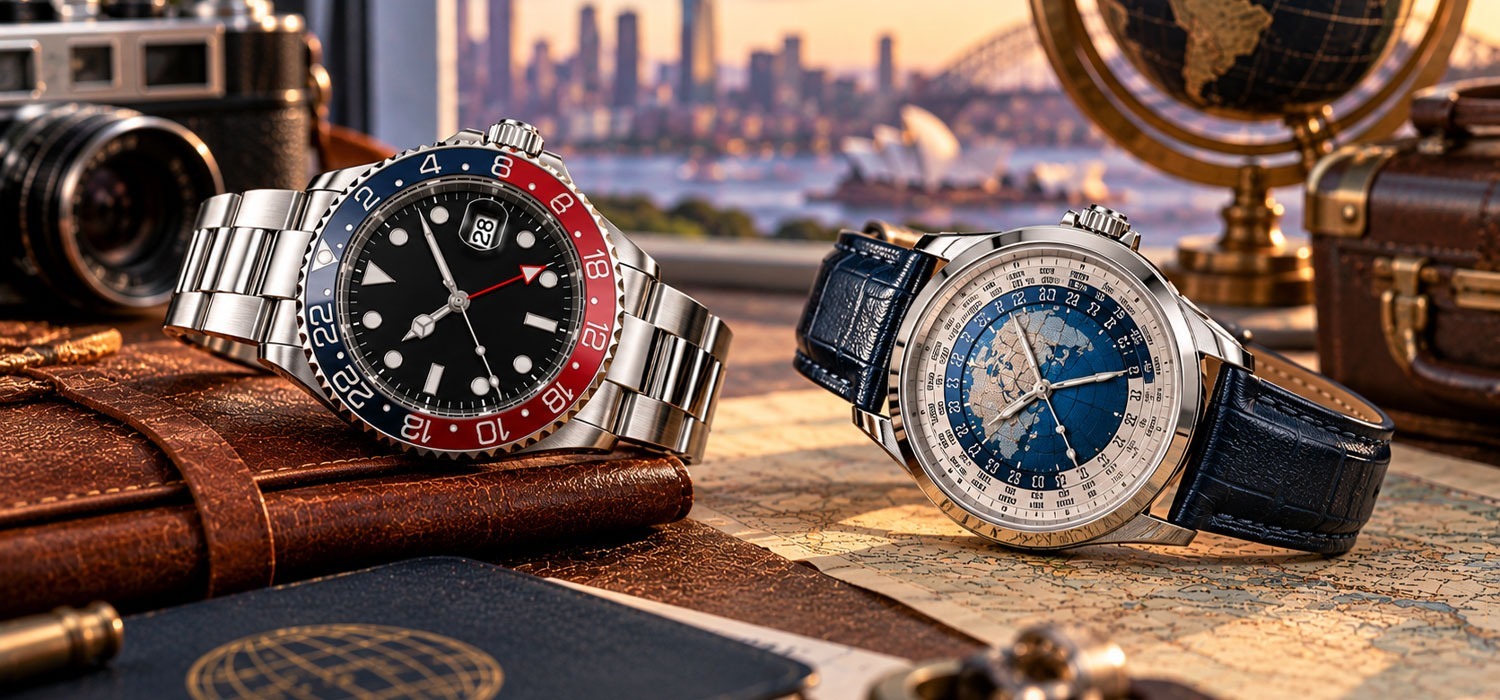
A GMT watch displays the time in two different time zones using a conventional set of watch hands and an additional 24-hour hand.
The GMT hand completes one rotation during 24 hours and points to a corresponding 24-hour scale. This allows the wearer to distinguish morning from evening in the second time zone.
Some GMT watches also feature a rotating 24-hour bezel, allowing users to read the time in a third time zone.
There are two common configurations: traveler GMT watches, which allow independent local-hour adjustments, and caller GMT watches, which typically adjust the GMT hand independently.
GMT watches are particularly useful when you frequently communicate with people in another country or travel between two locations.
What Is a World Timer Watch?
A world timer watch is a timepiece designed to display the current time across all 24 standard time zones simultaneously.
Unlike a GMT watch, which focuses on a single additional time zone, a world timer watch provides a broader view of time around the world.
Traditional mechanical world timers use rotating rings marked with representative cities and a 24-hour scale. Their arrangement allows you to identify the approximate local time in multiple destinations without changing your watch's primary display.
Worldtimer designs are often associated with international travel, global business operations, and enthusiasts who appreciate mechanical watch complications.
The Three Main Parts of a World Timer Watch
A traditional world timer generally includes three main components.
1. City Ring
The outer ring displays city names representing the 24 standard time zones.
Common examples include New York, London, Paris, Hong Kong, and Tokyo.
Each location corresponds to a time-zone position on the dial.
2. Rotating 24-Hour Ring
A separate 24-hour ring displays the hour associated with each city.
Many watches divide this ring into light and dark sections to help distinguish daytime from nighttime.
The ring typically completes one rotation every 24 hours.
3. Central Watch Hands
The main hour and minute hands showcase the local time.
Together, these components allow the wearer to read the local time while checking the time in other cities around the world.
How to Read a World Timer Watch
Reading a traditional world timer becomes easier once you know how the city ring and 24-hour ring work together.
Consider an example using standard time during winter.
Suppose you're in New York, and the local time is 3:00 p.m.
Step 1: Find New York on the City Ring
Locate New York among the city names. In a traditional reference layout, the local city is positioned at 12 o'clock.
Step 2: Read Your Local Time
The central hands indicate 3:00 p.m.
The 24-hour ring should show 15 beside New York.
Step 3: Find Another City
Locate London on the city ring.
In this winter example, London is five hours ahead of New York, so the ring displays 20, which means 8:00 p.m.
Step 4: Check Tokyo
Tokyo is 14 hours ahead of New York during standard time.
The ring displays 5 beside Tokyo, indicating 5:00 a.m. the following day.
This arrangement allows you to check multiple locations without manually adjusting the central hands.
How to Set a World Timer Watch
Setting a traditional world timer usually involves positioning your reference city and setting the local time.
The process commonly follows these steps:
- Select your local city using the appropriate crown position or pusher.
- Position that city at the watch's reference point, commonly 12 o'clock.
- Set the central hands to your current local time.
- Align the 24-hour ring according to the watch's instructions.
- Confirm that the displayed times for other cities are correct.
Exact procedures vary between manufacturers.
Some watches use dedicated pushers to change the reference city, while others rely on crown adjustments.
Always consult the watch's instruction manual before changing its settings.
What Should You Check Before Choosing a World Timer?
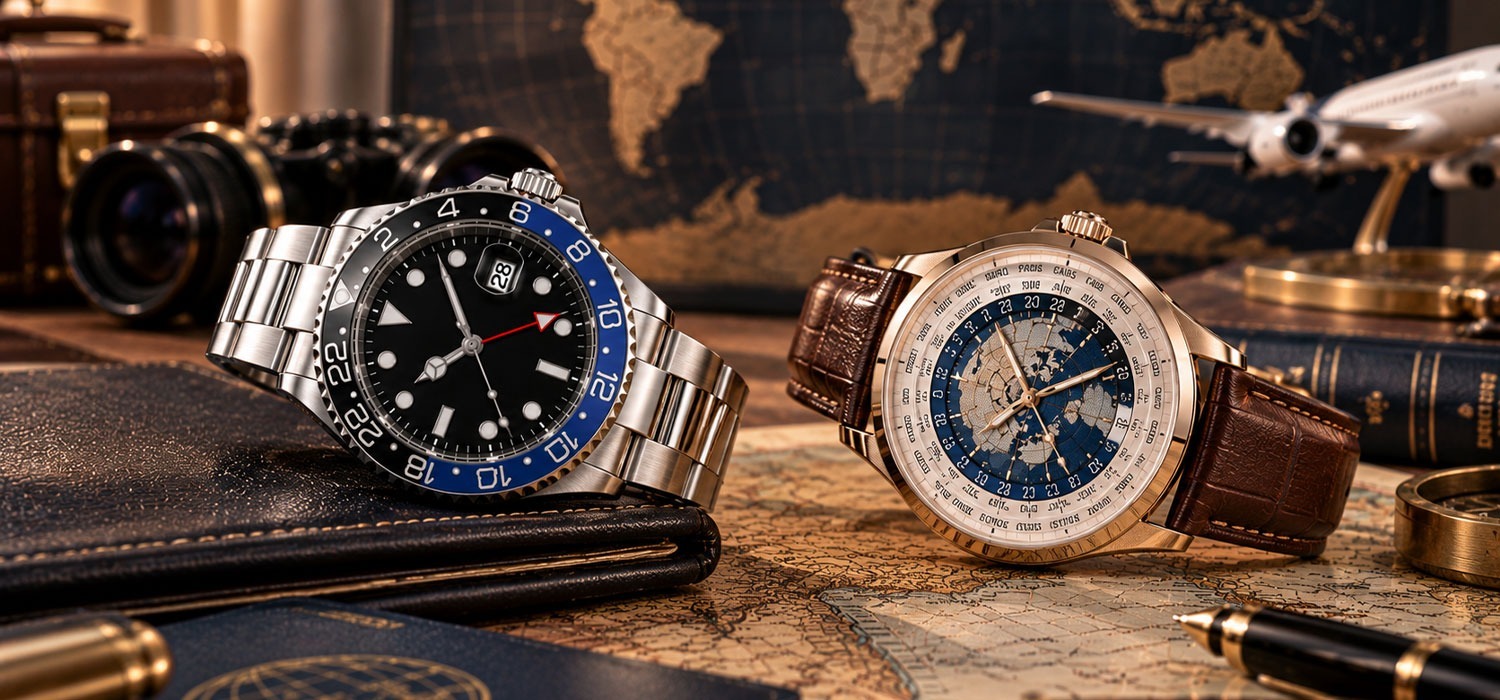
A world timer offers convenience, but several details affect how useful it will be.
City Selection
Check whether the cities or representative time zones you regularly monitor appear on the ring.
Dial Readability
World timers contain more markings than conventional watches. Make sure you can comfortably read the city names and corresponding hours.
Daylight Saving Time
Confirm whether a city currently observes daylight saving time. Some traditional city-ring displays require a manual adjustment or mental calculation when seasonal clock changes apply.
Nonstandard Time Zones
Some destinations use time-zone offsets of 30 or 45 minutes rather than whole hours.
Traditional 24-zone displays may not directly represent these offsets.
Movement and Display
World-time functions are available in mechanical, quartz, and digital watches.
Many digital Casio watches include a world-time mode that allows users to select cities electronically.
The choice depends on whether you prefer a traditional analog display or a digital interface.
Where Dual-Time Watches Fit
A dual-time watch displays two time zones, typically using a separate 12-hour subdial or an additional set of hands.
Unlike a conventional GMT watch, a traditional dual-time watch does not necessarily use a 24-hour scale.
This makes the second time easier to read in the familiar 12-hour notation, although it can create ambiguity about whether the displayed hour refers to the morning or the evening.
For example, a dual-time watch might show 9:00 locally and 6:00 in another destination.
Without an AM/PM indicator or 24-hour reference, you may need to remember whether the second location is six in the morning or evening.
A dual-time-zone watch is useful when you regularly monitor an additional location and prefer a straightforward display.
The GMT vvs. dual-time decision, therefore, depends largely on whether a 24-hour indication is important to you.
GMT vs World Timer vs Dual Time: Pros and Cons
Each complication offers advantages and limitations. The choice depends on how you use the watch, not on which design offers more features.
GMT Watch
Advantages
- Clear display of an additional time zone
- A 24-hour hand distinguishes AM from PM
- Rotating bezels can support a third time zone
- Suitable for monitoring home and local time
Limitations
- Does not display every global time zone
- Reading a third zone may require additional interpretation
- Adjustment methods differ between GMT movement types
World Timer Watch
Advantages
- Displays all 24 standard time zones together
- Convenient for checking several international locations
- Offers a distinctive dial with additional information
- Reduces the need for repeated city-by-city calculations
Limitations
- Smaller city names can be difficult to read
- Dials are often more crowded
- Daylight saving and fractional time-zone offsets may require adjustments
Dual-Time Watch
Advantages
- Straightforward second time display
- Familiar 12-hour reading format
- Useful for monitoring one additional location
Limitations
- Does not display numerous zones together
- Some models lack an AM/PM indicator
- Offers less information than a traditional 24-hour GMT display
Hybrid Watches: When a Watch Is Both
Some watches combine GMT functionality with world-time markings, creating a hybrid display.
These designs typically use a GMT hand alongside a bezel or ring marked with international cities.
They provide the familiar readability of a GMT while offering reference points for additional time zones.
However, a city-marked bezel does not automatically mean the watch independently displays all 24 zones like a traditional world timer.
According to Time and Tide's coverage of GMT and world-time complications, examples of watches using related hybrid approaches include models from Alpina, Raymond Weil, Mido, and Rado.
These include designs associated with the Alpina Startimer Pilot Quartz World Timer, Raymond Weil Freelancer Worldtimer GMT, Mido Ocean Star Decompression Worldtimer, and Rado Captain Cook Over-Pole.
You can browse the corresponding brand selections at Inventory Adjusters:
When reviewing a product listing, look for terms such as "GMT," "24-hour hand," "city ring," or "world-time bezel."
Check the specifications carefully to know whether the watch displays multiple zones simultaneously or requires additional calculations.
Which Should You Choose: GMT or World Timer?
The right multiple-time-zone watch depends on how many locations you need to monitor and how often you check them.
Choose a GMT If You Need Two Time Zones
If you regularly travel between your home city and another destination, a GMT watch is often the more practical choice.
It lets you view local time and home time without switching between displays.
A GMT is also useful when your family, clients, or colleagues are based in another country.
Choose a GMT With a Rotating Bezel for Three Zones
If you occasionally monitor two additional locations, a GMT watch with a rotating 24-hour bezel can provide an additional time reference.
This arrangement works well when you need more than two zones but still prefer a relatively simple watch face.
Choose a World Timer for Multiple International Locations
If your work involves offices across several continents, a world timer offers a broader reference.
You can check the approximate time in numerous destinations by reading the city and 24-hour rings.
A world timer is particularly helpful when you frequently coordinate meetings across several countries.
Choose Based on Readability
A GMT offers a simpler layout with fewer markings.
A world timer provides much more information but requires familiarity with its city ring.
If you prefer a clear dial and rarely need more than two or three zones, choose a GMT.
If you regularly monitor many international cities, a world timer may suit your routine better.
When selecting a travel watch, also consider case size, comfort, movement type, and water resistance.
Our guide to choosing a watch for your lifestyle covers those broader considerations.
A Short History of GMT and World Timer Watches
The development of world-time watches is closely associated with Swiss watchmaker Louis Cottier.
Building on his father Emmanuel Cottier's earlier work, Louis developed and refined his world-time mechanism by 1931.
Historical records from Collectability and SJX indicate that his first Patek Philippe world-time watch was delivered in 1937.
The complication became closely associated with the French term heures universelles, meaning universal hours.
GMT watches developed along a different path.
The Glycine Airman, introduced in 1953, is widely recognized as an early wristwatch designed to track multiple time zones.
Rolex later introduced the GMT-Master in the mid-1950s, designed to meet the needs of Pan American World Airways pilots.
Both approaches remain important in modern watchmaking.
Frequently Asked Questions
What Is the Difference Between a GMT and a World Timer?
A GMT watch tracks one additional time zone using a 24-hour hand, and sometimes supports a third time zone via a rotating bezel. A world timer displays all 24 standard time zones simultaneously using city and 24-hour rings.
Is a World Timer Better for Travel Than a GMT?
Not necessarily. A GMT is useful when traveling between two locations or monitoring home time. A world timer is better suited to checking multiple international time zones without repeatedly adjusting the watch.
Are GMT Watches More Accurate Than World Timers?
No. Timekeeping accuracy depends on the watch movement, its regulation, and its condition. A GMT or world-time complication changes how time zones are displayed, not the movement's inherent accuracy.
What Is a Dual-Time Watch?
A dual-time watch displays a second time zone, commonly through a separate 12-hour subdial. Unlike a traditional GMT, it may not use a 24-hour scale to distinguish morning from evening.
Can a Watch Be Both a GMT and a World Timer?
Yes. Some hybrid watches combine an additional GMT hand with city markings or a world-time bezel. Their exact capabilities vary, so check whether the model provides simultaneous world-time readings or requires manual interpretation.
Do World Timer Watches Adjust for Daylight Saving Time?
Not all world timers adjust automatically. Traditional city-ring models may require manual changes or mental calculations when destinations observe daylight saving time. Check the watch's instructions and the current time-zone rules for each city.
GMT vs World Timer: Find the Right Watch for Your Needs
When choosing between GMT and world-timer watches, start by counting the time zones you actually need.
Choose a GMT for clear local and reference times, or a world timer for a broader international view.
Browse men's sport watches and watch collections from Alpina, Raymond Weil, Mido, and Rado at Inventory Adjusters to compare suitable designs.
Newest Guide & Blog Updates

Who Actually Needs a GMT Watch?
Yes, if you regularly need a second time zone, want a quick 24-hour AM/PM reference, or simply love...

GMT vs. World Timer Watches: What's the Difference?
A GMT watch tracks one additional time zone, while a world timer watch displays all 24 standard tim...

What Is a GMT Watch and How Does It Work?
A GMT watch is a wristwatch that displays a second time zone using an additional hand that complete...

How to Match a Watch Strap to Your Style and Occasion
Your watch looks perfect with jeans, but something feels wrong when you wear it with a suit. Or per...

How to Choose the Right Watch Strap Material
Your watch strap does more than hold your watch in place. It affects how comfortable your wrist fee...

Watch Bracelets vs. Leather Straps: Which Is Right for You?
You've found the watch you want, but there's one decision left. Should you buy it with a metal brac...