
What "Water Resistant" Really Means in Daily Use
Most people assume that buying a water resistant watch means they can wear it anywhere in the shower, at the pool, or even in the sea. It is one of the most common misconceptions in the watch-buying world, and it leads to thousands of damaged timepieces every year. The term water resistant watch has a far more specific and far more limited meaning than most buyers realise.
A water resistant watch is not the same as a waterproof watch. Every water resistance watch has a defined limit measured in metres or ATM (atmospheres of pressure), and exceeding that limit even briefly can allow moisture to penetrate the case, corroding the movement and ruining the dial.
Below, we break down exactly what water resistance means across the most popular types of watches, explain how to read those ratings in real-world terms, and help you choose the right water resistant watches for your lifestyle. Whether you are shopping for water resistant watches for men or buying as a gift, understanding this specification will help you make a far more confident decision.
Water Resistant Watch Meaning Explained.
The ISO 22810 international standard defines water resistance watch ratings for wristwatches. Every compliant watch is tested in a controlled environment where pressure is applied to simulate depth, but this is static lab pressure, not real-world activity. Dynamic movement, pressure changes from swimming strokes, and temperature fluctuations all increase effective stress on the seals, which is why real-world limits are always lower than the lab rating.
Think of the rating as a safety ceiling, not a target. If your watch is rated 30 metres, that does not mean it is designed for swimming 30 metres underwater. It means it has passed a static pressure test equivalent to that depth, and even then, real-world use should be far more conservative.
The bottom line: a water resistant watch protects within defined limits. Those limits vary widely, and knowing where your watch sits on the scale is the first step to protecting your investment.
Understanding Water Resistance Levels
|
Rating |
Meters / ATM |
What It Handles |
Safe Activities |
|
30m / 3 ATM |
30m |
Splashes, rain |
Hand washing |
|
50m / 5 ATM |
50m |
Light swimming |
Brief pool dip |
|
100m / 10 ATM |
100m |
Swimming |
Laps, snorkelling |
|
200m+ / 20 ATM+ |
200m+ |
Diving |
Scuba, water sports |
Understanding these water resistance levels is critical before purchasing any water resistant watch. Here is what each level means in practice:
30m / 3 ATM — Splash Resistant
This is the entry-level water resistance rating. A water resistance watch at 30m is suitable for accidental splashes, light rain, and hand washing. It should never be submerged, worn in the shower, or used while swimming. Many dress watches and fashion timepieces carry this rating.
50m / 5 ATM — Light Water Contact
At 50m, water resistance levels allow for more confident everyday use. This rating covers brief contact with water — quick hand washing, being caught in heavy rain, or even a momentary submersion. Most experts still advise against swimming regularly at this rating.
100m / 10 ATM — Swimming Ready
A water resistant watch rated at 100m is genuinely suitable for recreational swimming, snorkelling, and surface water activities. It can handle regular pool use and casual beach wear. This is the minimum rating recommended for active swimmers.
200m+ / 20 ATM+ — Diving Grade
These water resistance levels are designed for serious water sport participants and divers. At 200m and beyond, a watch can handle scuba diving, high-pressure water jets, and extended submersion. Most top-tier water resistant watches for men in the sports category carry this rating.
Water Resistant vs Waterproof Watch: Key Differences
The word 'waterproof' has been largely banned from legitimate watch marketing because it implies absolute protection that no mechanical or electronic timepiece can offer. ISO standards recognise no such thing as a waterproof watch, only water resistant watches with certified ratings.
So what is the difference between water resistant and waterproof? In practical terms:
- A water resistant watch has a tested, defined limit. Protective within that limit only.
- Waterproof watch — a marketing term with no accepted industry standard. Treat any watch labelled 'waterproof' with scepticism unless it also carries a certified ATM or metre rating.
- The higher the ATM rating on your water resistance watch, the more water activity it can handle — but 'waterproof' alone means nothing without a number.
This distinction in the water resistant vs waterproof watch conversation is especially important when buying online, where product descriptions sometimes overstate a watch's water tolerance.
What Water Resistance Means in Daily Use
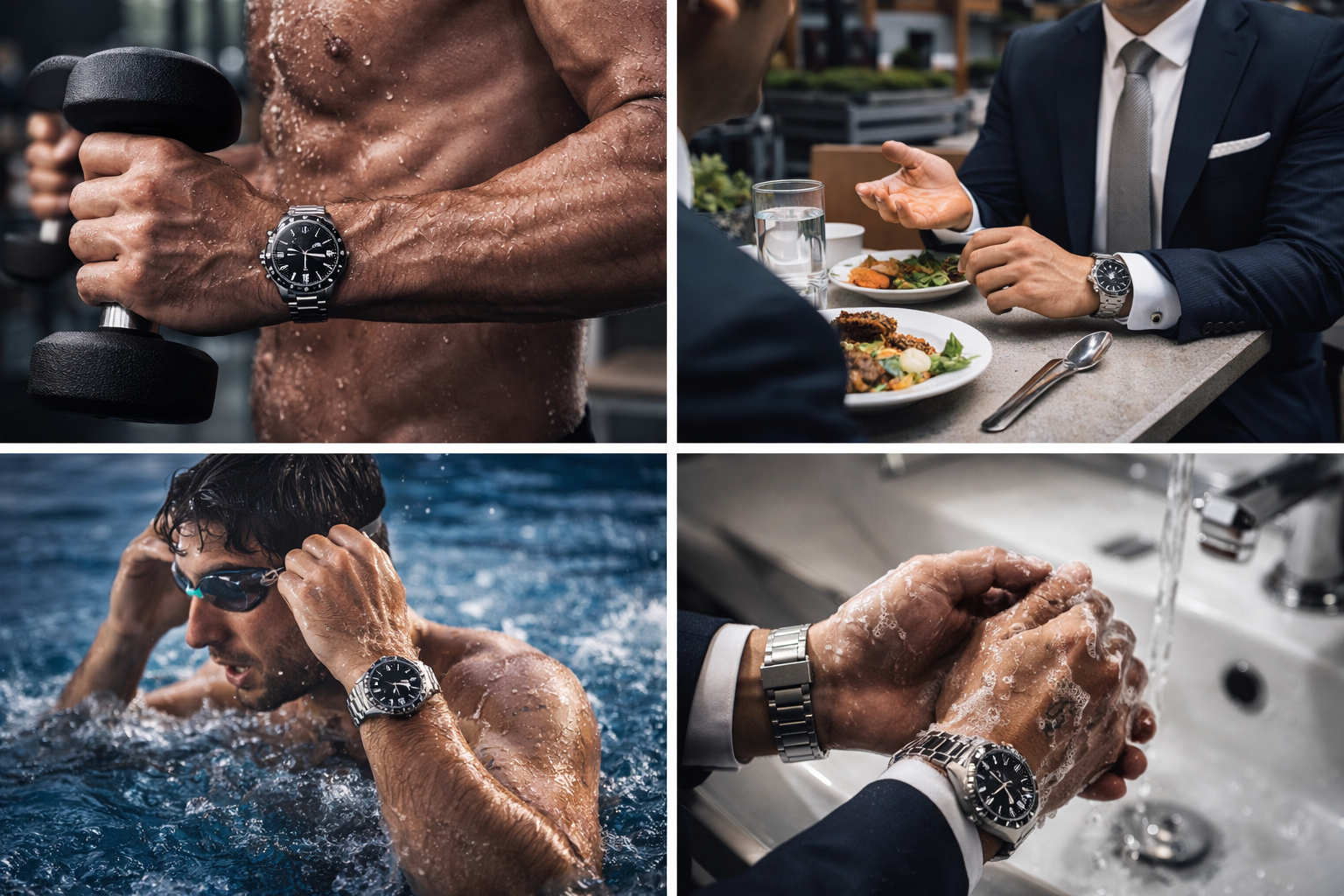
Specifications on paper are only useful if you understand what they mean when you are actually living your day. Here is how different water exposure scenarios translate to your watch's rating:
Washing Your Hands
Any water resistant watch rated 30m / 3 ATM or above will handle everyday hand washing without issue. Brief contact with running water at normal temperature poses no risk. Simply avoid submerging the crown or leaving water to pool around the pushers.
Caught in Rain
Rain exposure is well within the tolerance of any water resistant watches rated 30m or above. Light showers and heavy rain are both fine. The concern is not rain itself but extended saturation combined with temperature changes, so avoid wearing a low-rated watch in a sustained downpour if you can.
Showering
This is where many watch owners make mistakes. Hot water weakens and degrades rubber seals over time, even on watches rated to 100m. Unless your water resistance watch is rated 200m or higher, it is best practice to remove it before showering. Hot steam is particularly damaging; it forces moisture into gaps that cold water cannot penetrate.
Swimming
Recreational swimming requires a minimum of 100m / 10 ATM on your water resistant watch. The physical pressure of swimming strokes, combined with repeated submersion, generates more stress than the watch encounters in lab testing. Do not swim with a 30m or 50m rated timepiece.
Gym and Active Use
Sweat is a significant concern for water resistant men's watch buyers who train regularly. Sweat contains salts that can corrode seals and degrade finishes over time. For gym use, opt for a water resistant watch rated at least 50m, and rinse the case with fresh water regularly to remove salt residue.
Choosing Water Resistant Watches for Men and Women
When shopping for water resistant watches for men, the right rating depends on your lifestyle rather than your style preference. A water resistant men's watch for daily office wear, paired with occasional outdoor activity needs a minimum of 50m. For a man who swims regularly or works in a physically demanding environment, 100m should be the baseline.
For water resistant watches for women, the choice is often balanced between elegance and practicality. Many women's dress watches carry only 30m ratings sufficient for daily wear but not for water activities. If you lead an active lifestyle or want a watch that can comfortably handle gym sessions and outdoor adventures, seek out water resistant watches rated 50m or above in a style you love.
Key guidance by use case:
- Office and daily wear: A 30–50m water resistant watch is sufficient
- Active lifestyle, gym, and swimming: minimum 100m water resistant watches for men or women
- Water sports, diving: 200m+ rated water resistance watch required
Browse our collection of water resistant watches for men and women at Inventory Adjusters to find the right rating for your routine.
How Water Resistance Varies Across Types of Watches
Not all types of watches are built with the same water resistance priority. Understanding how different watch categories approach water protection helps you set the right expectations before buying.
Casual Watches
Most casual water resistant watches are rated between 30m and 100m. They are designed for everyday wear and can handle normal moisture exposure, but they are not built for swimming or water sports. The focus is on style and comfort, with water resistance as a secondary specification. Most water resistant watches for men in the casual category fall in this range.
Dress Watches
Dress watches typically carry the lowest water resistance levels, often just 30m. These are formal timepieces designed for controlled environments. Handle them carefully around water, and never wear a dress watch to the beach or pool.
Sports Watches
Sports watches are engineered with water activity as a primary design requirement. They typically carry 100m to 200m+ ratings, feature screw-down crowns, thicker case backs, and enhanced gasket systems. If water performance matters most, a sports-oriented water resistance watch is the correct category.
Best Watch Brands for Water Resistance and Durability
When evaluating the best watch brands for water resistance, build quality matters far more than the brand name alone. The most reliable water resistant timepieces share common construction features:
- Stainless steel case — minimises corrosion risk and provides a solid seal base
- Screw-down crown — locks the most vulnerable entry point against water ingress
- Rubber or silicone gaskets form the primary seal between case components
- Sapphire or hardened mineral crystal — resists pressure without cracking
Among the best watch brands for water resistance in the affordable and mid-range segment, quality construction with proper sealing consistently outperforms marketing claims. Inventory Adjusters offers water resistant watches designed for everyday durability and practical use, built with tested water resistance ratings you can trust.
When buying any water resistant watch, always verify the ATM or meter rating is explicitly stated, not just the vague term 'water resistant' and check whether the crown is screw-down or push-pull. A push-pull crown is a significant vulnerability at any depth.
Common Mistakes People Make with Water Resistant Watches
Even buyers who understand water resistance ratings frequently damage their watches through avoidable habits. Here are the most common errors:
Wearing It in the Shower
Hot water and steam are the leading causes of water resistant watch seal failure. Heat causes rubber gaskets to expand and contract, gradually compromising their integrity. Even if your watch is rated 100m, showering in hot water repeatedly will degrade its water protection faster than any swimming session.
Ignoring the Crown Position
The crown is the most common entry point for water. Always ensure the crown is fully pushed in or screwed down if your watch has a screw-down crown before any water exposure. Operating the crown while wet is one of the fastest ways to force moisture into the movement.
Never Servicing the Seals
Water resistance is not a permanent property. The gaskets and seals inside a water resistance watch degrade over time, typically requiring inspection and replacement every 18 to 24 months if you use the watch near water regularly. An untested water resistant watch that has not been serviced for several years should be treated as offering no meaningful water protection.
Pressing Buttons Underwater
Chronograph pushers and function buttons are additional entry points. Never press any button on a watch while it is submerged unless the watch is explicitly designed and rated for underwater pushbutton operation.
Switching from Hot to Cold Rapidly
Thermal shock, rapidly moving a watch from a hot environment (sauna, hot tub) to cold water, can stress seals and, in some cases, crack the crystal. Avoid extreme temperature changes regardless of your watch's water resistance rating.
How to Choose the Right Water Resistant Watch
Matching your water resistance rating to your actual lifestyle is the most practical buying decision you can make. Here is a simple framework:
- Daily office wear, light outdoor use → water resistant watch rated 30–50m is appropriate. Most water resistant watches for men and women in the casual category fit this use case perfectly.
- Active lifestyle — gym, running, cycling, beach trips → Choose water resistant watches rated 100m / 10 ATM. This provides confidence for swimming and water-adjacent activities without entering sports watch territory.
- Water sports, regular swimming, snorkelling → Minimum 200m / 20 ATM water resistance watch. Look for screw-down crowns and manufacturer-tested dive ratings.
- Gift buying → If uncertain about the recipient's lifestyle, a 100m water resistant men's watch or women's watch is the safest middle ground — practical for most activities without overspecifying.
Explore our full range of casual water resistant watches to find the right rating for your daily routine.
FAQs
1. What is a water resistant watch?
A water resistant watch is designed to handle limited moisture exposure and is tested at specific pressure levels (ATM or metres).
2. What does water resistant mean on a watch?
It indicates the pressure level the watch can withstand, e.g., 30m means splashes and rain, not swimming.
3. What is the difference between water resistant and waterproof?
No watch is truly waterproof. Water resistant watches have tested limits, while “waterproof” is not a reliable standard.
4. Can I swim with a water resistant watch?
Only if it’s rated 100m or higher. Lower ratings are not suitable for swimming.
5. Are water resistant watches safe for showering?
No. Heat and steam can damage seals and reduce water resistance.
6. What are water resistance levels?
They are pressure ratings (e.g., 30m, 50m, 100m, 200m+) that indicate how much water exposure a watch can handle.
7. How long does water resistance last?
Not permanently. Seals degrade over time, so regular servicing is recommended.
Final Thoughts
The water resistant watch's meaning is not a simple one; it is a spectrum of protection tied to tested pressure limits, seal quality, and real-world usage habits. Understanding water resistance levels, respecting what water resistant watches can and cannot handle, and maintaining your seals regularly will protect your investment and give you confidence every day you wear it.
Whether you are choosing water resistant watches for men, shopping for water resistant watches for women, or simply trying to make sense of a spec sheet, the key is always to match the rating to your actual lifestyle, not your wishful thinking.
Shop water resistant watches at Inventory Adjusters and find your perfect match built for the way you actually live.
Newest Guide & Blog Updates
What "Water Resistant" Really Means in Daily Use
Most people assume that buying a water resistant watch means they can wear it anywhere in the showe...

Understanding Watch Materials: Stainless Steel, PVD, Gold-Tone Explained
When shopping for watches for men or choosing a timepiece as a gift, the watch material is one of...

Anniversary Gift Ideas- Watches That Feel Luxurious Without the Luxury Price Tag
An anniversary gift should last as long as the occasion it marks. That is why anniversary gift idea...

How to Spot an Authentic Coach Watch Online (Buyer’s Checklist)
Counterfeit listings have gotten better at looking real, so we can no longer rely on a single photo...

Dress Watch vs. Sport Watch vs. Casual Watch: Which One Should You Buy?
When choosing a watch, it’s essential to understand the distinct differences among the types availa...

What Watch Collectors Look for Beyond Brand Names
A watch that truly matters does not need to announce itself with a logo. The moment you hold a well...